
Put the breaks in while you still have the energy.
That is the whole letter, really. The rest is where mine went.
It is September and your calendar is full. Every week from now to May has something written in it, because that is what a calendar looks like when you fill it in August with a new pen and a whole summer of rest behind you. It looks like a finished year. It looks like proof.
Then the first week slips. Somebody runs a fever on Monday, the dentist takes Thursday morning, and co-op day eats the day before it and the day after. Now every week after that one slides down a row, and the last week of the year has nowhere to go.
I wrote last time about the October when the plan stops describing your life. Most of the fix for that happens now, in September, and at our house it started with the breaks. They went in first.
Start with the number the year actually needs
Thirty-four. That is the number I planned around, more often than not.
Here is how I got there. A lot of co-ops run a 28-week year, and I know from experience that 28 weeks was not enough to finish the other curricula we used at home. Some of those curricula wanted 36 weeks, and 36 always seemed to be the ceiling. So I landed in between, nearer the top than the bottom. Thirty-four weeks of lessons gave me a little leeway, it felt like a good medium, and it stayed my number.
Your number might be different. What matters is that you pick it on purpose, from the books on your own shelf, instead of letting the calendar pick it for you.
Weeks and days are two different counts
My state does not ask me for weeks. It asks for 180 days, and that is a different number entirely.
Thirty-four weeks of lessons was never going to be 180 days of sit-down academics, and it never had to be. Some of the days I counted were not traditional academics at all. I count them anyway, because I believe education is always happening, and by the middle of May I always knew we had done enough.
The mix moved from year to year, too. Some years ran heavier on the books. Other years ran lighter at the table, and more of what I counted happened somewhere other than a lesson. It came out close to the same either way, because the day count never cared which kind of day it was.
Find out what your own state asks of you, because states do not all ask the same thing. Then set that number aside. It is a record you fill in as the year goes, not a plan you build in September. The books on your own shelf decide how many weeks you schedule.
Then count what the calendar holds
We started at the end of August and finished in the middle of May. Count that out on a calendar and you get about thirty-seven weeks.
Thirty-seven weeks on the calendar. Thirty-four weeks of lessons. The rest had names, and the names were Christmas and Thanksgiving. In the years we took three weeks at Christmas instead of two, the lessons gave one back.
That is the whole shape of it, and it is the part I want to say plainly. I never planned an empty week. I planned fewer weeks than the calendar held, and I gave the rest names.
Last time I told you to leave weeks empty, and I meant it. But at our house, empty was never a blank. It was Christmas. It was Thanksgiving. Both of them were on the calendar before a single lesson was.
Put the named breaks in first
Mine went on the calendar before the lessons did.
Christmas and New Year's. Every year I decided how much time we wanted off, and it was never less than two weeks. Some years we took three. Decide that in September and write it down. December is not the month to do that arithmetic.
Thanksgiving. For us that week was often travel, so it went on the calendar as travel. I did not pretend it was a school week.
The bonus weeks. Once I had children in college, their breaks sometimes landed on a co-op off week, and that was a special bonus. I took it as one.
The one-offs. One year I directed a play at our church over Easter, and that needed extra time off. So that year, Easter got more.
None of those were surprises when they came. That is the point. The calendar knew about Christmas in September.
Stack the vacation on a week you already have off
Because we homeschool, we can go to Florida when we choose, and we still do. Here is how it fits without losing a week of school.
Thanksgiving came off the calendar as time off. This week never did. It was a school week that happened somewhere warmer.
Our co-op had off weeks built into its year. We would take one of those, add a week onto it, and miss a single co-op week. The books came with us, we did the work where we were, and we came home caught up.
If your co-op or community has off weeks, look at those first. One of them is probably your vacation, and the week beside it is the one you add. If you have no co-op, you have every week to choose from, so choose now, while it costs nothing, and write it down.
Where Homeward Days comes in
For twenty years I have done this by hand, and the counting is mine to carry: the number, the span, the breaks, the days, and whether it all still fits before the middle of May.
Homeward Days does the counting. It builds the year schedule around the breaks you name, it keeps a little room spread through the year for the weeks that go sideways, and the days you check off count themselves. It will never make you feel behind for taking the week you planned. Grace, not guilt, starts with the calendar.
Before the first week slips
You have the energy right now. That is the whole reason to do this in September instead of waiting for the week that makes you.
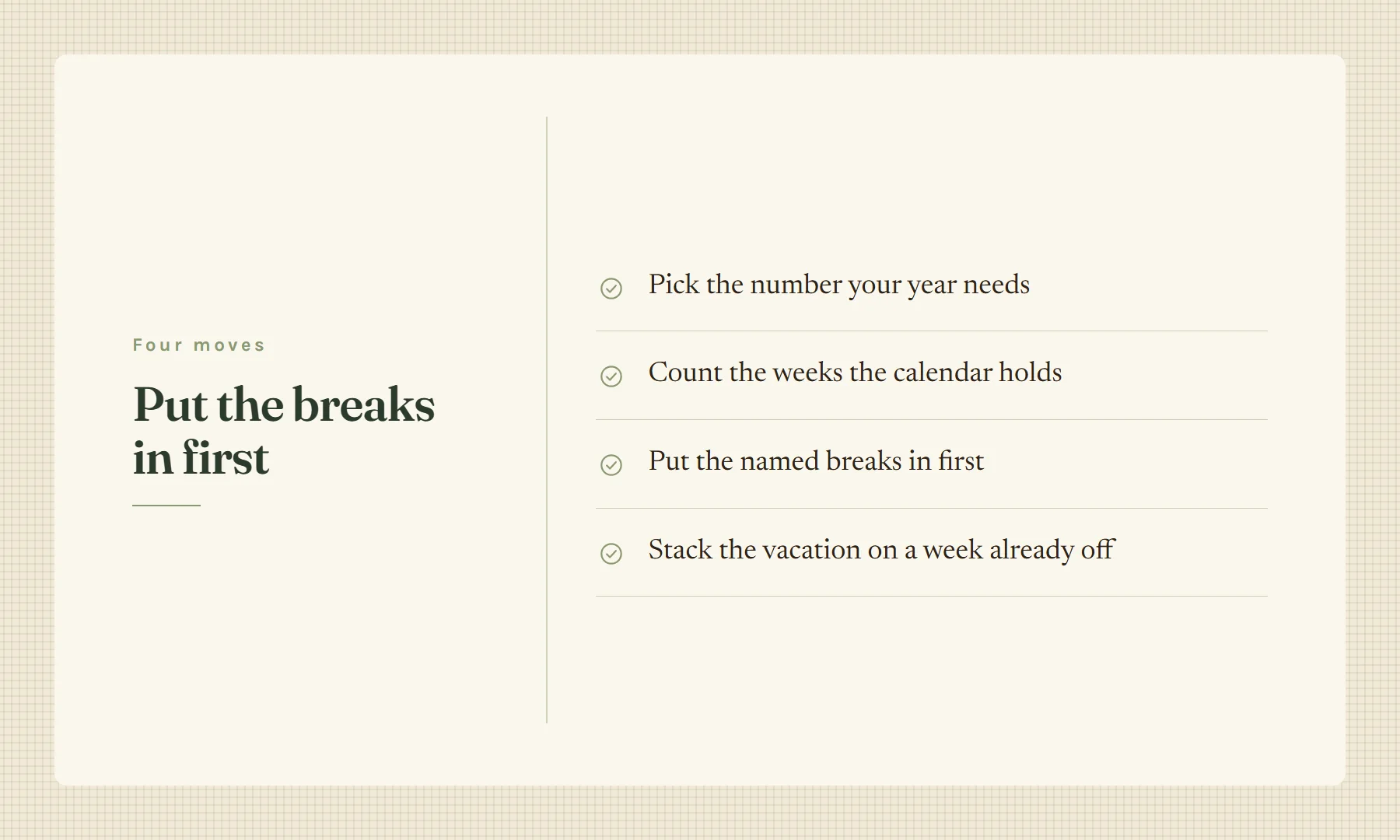
So take the calendar and make four moves. Pick the number your year needs. Count the weeks the calendar holds. Put the named breaks in first. Stack the vacation on a week you already have off.
We are getting ready to open, and the founding list is how you hear first. Short letters, and nothing else. If you want in early, join the founding list. And if a friend's calendar is full to the last week of May, send her this while it is still September.
Tina